CG World.
<< BACK <<
Translation >
This is an article from CGWORLD (December 2005 issue) featuring an interview with artist Luke Bailey regarding his project, Moscow Souvenir.
The article explores how Bailey fused traditional painterly aesthetics with 3D computer graphics to create a unique, "borderless" style.
Borderless: Creating Painterly Realism with CG
Artist: Luke Bailey
Moscow Souvenir stood out at this year's SIGGRAPH Animation Theater for its exceptional artistry. We spoke with Mr. Bailey about the depths of this unique worldview, born from a fusion of painting and CG realism.
Text/Reporting: Noriko Kurachi
Realism Rooted in Thorough Research
Luke Bailey has loved drawing buildings and scenes from the lands he visits since he was a child. While sketching interesting scenes, he also developed an interest in traditional oil painting with its unique brushwork and became interested in the classical painters of the past. He wanted to reproduce the world of these 2D sketches and paintings in a 3D environment that felt closer to reality, which led him down the path of CG animation.
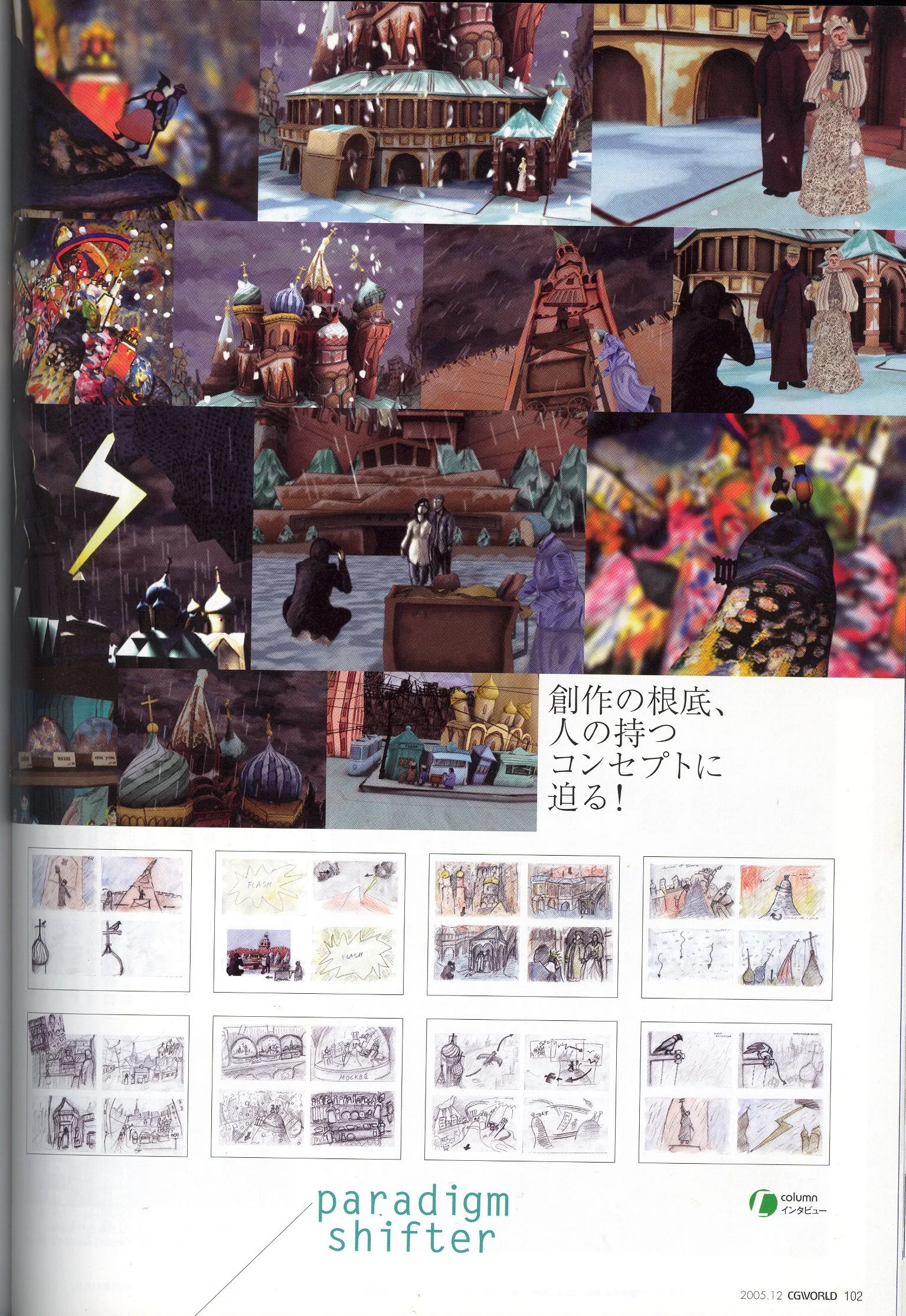
His first work to embody this vision, Moscow Souvenir, was heavily inspired by the paintings of Russian artist Wassily Kandinsky. Bailey initially created a 3D version of that painterly world, but felt that simply reproducing it was not enough; he wanted to depict the actual buildings and lives of the people in Moscow. For this reason, he collected all kinds of footage, from tourist promotional videos to films set in Moscow. He thoroughly researched Russian history and the lifestyles and clothing of people in various eras, creating numerous sketches. Finally, he visited Moscow himself to photograph the city streets and the lives of ordinary people. According to Bailey, the most important thing in direction is to "know the subject well," which requires sufficient research.
Meticulous Textures and Dedicated Animation
During production, Bailey spent the most time on the textures of the objects appearing in the scenes. He believes that the "essence" of art lies in the touch of the paint. It is this touch that makes a piece stand out as "pure art" and captivates the audience. In the case of entertainment, it becomes the key to bridging the gap with the viewer. To create a sense of realism that viewers can feel close to, Bailey manually painted delicate digital textures and added global illumination effects (diffuse/glossy). By layering these textures, he created the final surface qualities.
He also applied a similar level of ingenuity to the animation to breathe life into the work. For example, in a shot of a wedding, he used cloth simulation on the bride's dress to add reality to the movement. However, simply using off-the-shelf tools caused the hem of the dress to collide with the fabric in unnatural ways, making it impossible to get the desired movement. Therefore, he manually set rough movements for the chest and sleeves of the dress, then applied physics simulations to specific parts. By adding these complex processes, he was able to incorporate natural movements that didn't look mechanical, much like the spontaneous actions of people captured in video footage.
Pursuing Painterly Realism through CG
In the opening of Moscow Souvenir, snow globes are shown lined up at a Moscow souvenir shop. Within these globes, scenes from world cities like London, Paris, Rome, and New York are projected. The camera then selects a globe containing Moscow and dives into that world. Bailey chose Moscow not just for its connection to Kandinsky’s paintings, but because he wanted to draw the city’s eccentric, exotic buildings. He is also planning works themed around the other cities seen in the snow globes as a sequel.
Through this series of works, Bailey's goal is to achieve the "painterly realism" he has aimed for since coming to Japan. To him, realism isn't just about drawing patterns on a flat surface; it includes the light and movement of objects that move through 3D space. When these elements are realized in a way that viewers feel is close to them, the boundary between "pure art" and "entertainment" naturally disappears.
Sidebar Captions & Notes
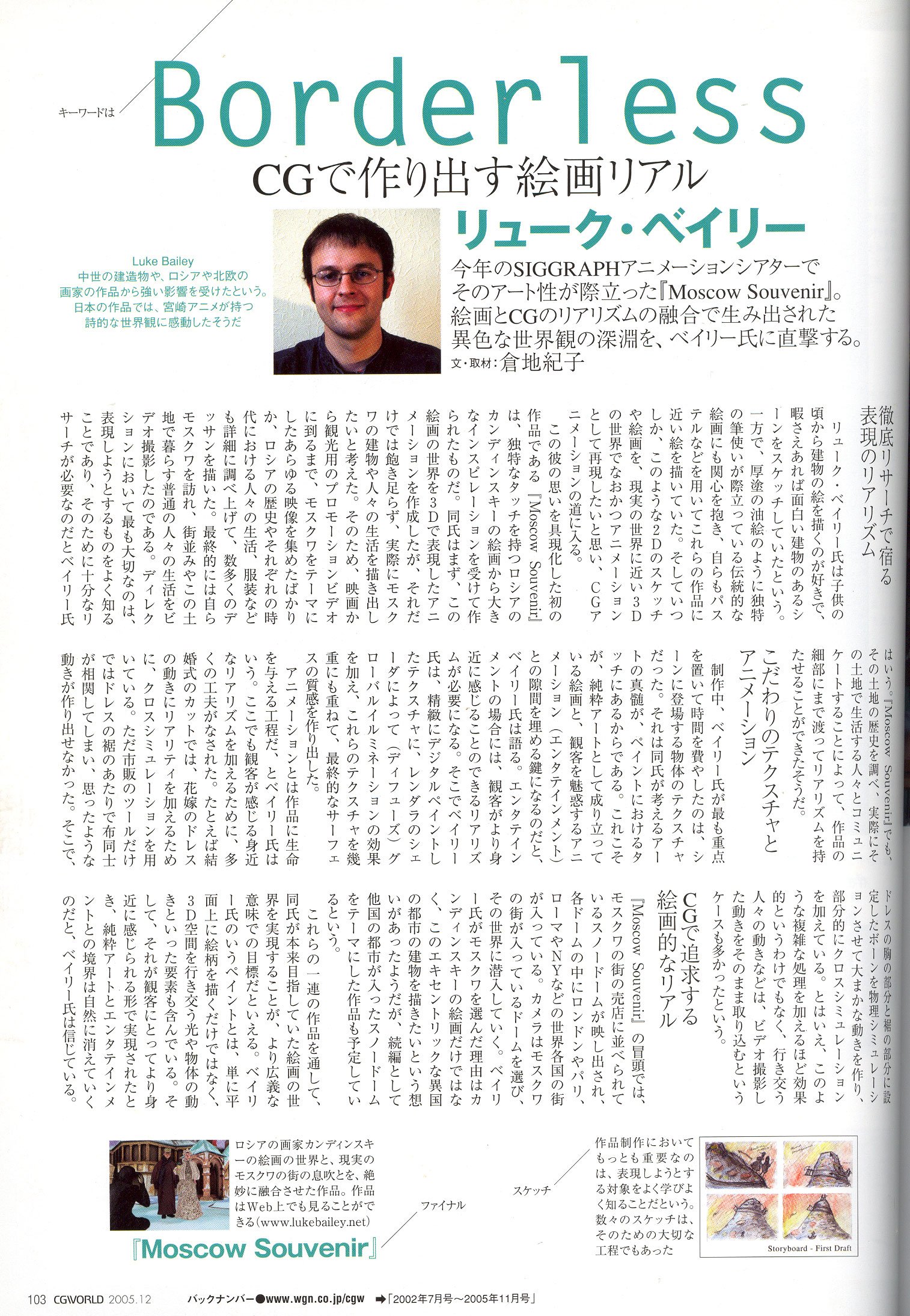
Top Left Quote: "Luke Bailey says he was strongly influenced by medieval architecture and painters from Russia and Northern Europe. He was also moved by the poetic worldview of Miyazaki's anime."
Bottom Image Caption: "A fusion of the painterly world of Russian artist Kandinsky and the actual atmosphere of the streets of Moscow. The work can also be seen on the web (www.lukebailey.net)."
Production Process (Bottom Right): The article shows a progression from Storyboard (First Draft) to Sketches and finally the Final rendered frame.
Key Insight: "The most important thing in creating a work is to study and know the subject you are trying to express well. Numerous sketches were an important process for that."